The 2025 Guide to Footwear Virtual Try-On: How AI & 3D Are Transforming Sneaker Sales
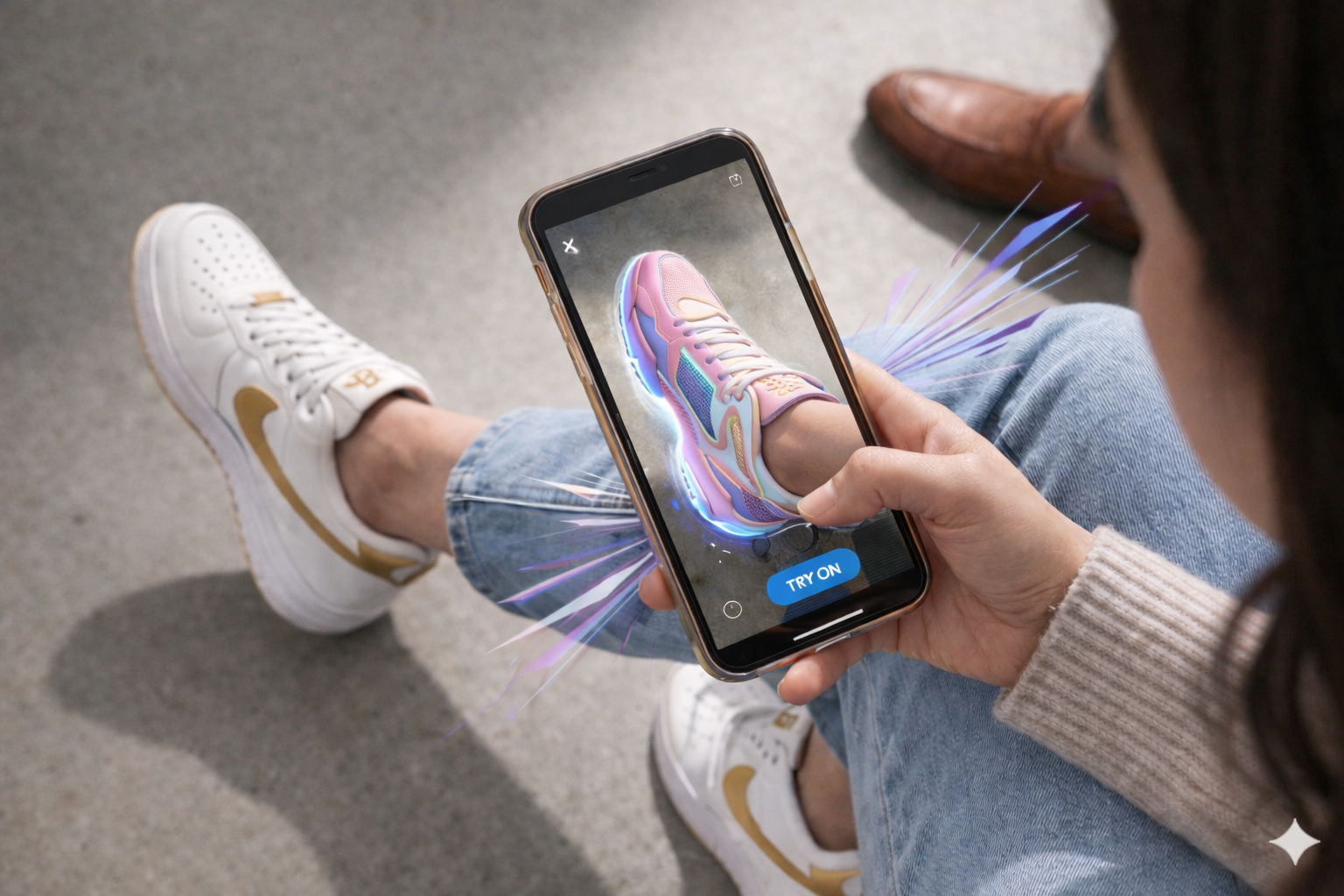


2025 marks a major turning point for Virtual Try-On (VTO), the 3D modeling and AI-powered product visualization technology that allows shoppers to experience a product, specifically high-return categories like footwear, realistically before making a purchase. Today, digital product interaction is no longer limited to a static image or a short video. Realistic, interactive, and confidence-building product experiences now define the decision-making process.
In 2025, the rapid rise of AI glasses and spatial computing is accelerating the adoption of Virtual Try-On, expanding it beyond mobile screens into hands-free, immersive shopping experiences.
What enables this shift is the increasing accuracy of AI-enhanced 3D VTO combined with platforms like artlabs, which make these experiences accessible and scalable for brands. According to performance data we share with our customers:
3D VTO integration → up to 71% increase in conversions
Accurate 3D product sizing → up to 28% reduction in return rates
78% of users prefer 3D interactions over 2D visuals
These numbers clearly demonstrate that VTO is no longer an optional innovation, it has become one of the most essential layers of a modern product detail page. As we’ve seen across dozens of deployments, shoppers now expect an interactive product experience. Not just a visual.
This leap in digital product experience is transforming not only how consumers shop but also how brands operate. Traditional 3D modeling workflows that once required weeks can now be completed 10x faster with artlabs’ AI-powered pipeline. Brands can generate photorealistic, lightweight, and fully optimized 3D models using nothing more than a few standard product photos. As a result, VTO implementations are now scalable even for brands with massive catalogs.
In this comprehensive guide, we explore how VTO works, why it has become indispensable, which product categories benefit most from each format, and how brands can successfully implement it.
Key Insights
Virtual Try-On has moved far beyond being an “innovative add-on” in e-commerce. As of 2025, VTO has become a core decision-making layer, one that strengthens customer confidence and sits at the center of the digital shopping journey.
Is VTO still a “nice-to-have,” or has it become central to conversion?
By 2025, VTO has evolved into a conversion-critical feature within product detail pages. Shoppers no longer want to merely see a product, they want to understand its true size, volume, and how it will look on them. This expectation makes VTO one of the foundational components of modern PDP design.
With the emergence of AI-powered smart glasses, VTO is evolving into a cross-device experience that users expect to work seamlessly across mobile, web, and wearable devices.
How does 3D VTO differ from traditional 2D visuals?
2D visuals show what a product looks like. 3D VTO shows how a product actually behaves in real space. If you think about your own shopping habits, this difference is instantly recognizable: We trust something more when we can see how it behaves.
Depth, scale, material behavior, and spatial accuracy play a decisive role in purchase confidence. That’s why 3D VTO closes the “reality gap” left by 2D imagery.
3D VTO also benefits from spatial AR principles, anchoring products true-to-scale in the user’s environment, something 2D visuals can never replicate.
Where does AI fit into this, and why does it accelerate VTO adoption?
In practical terms, AI is the invisible engine that makes VTO scalable. artlabs’ AI-powered pipeline generates photorealistic 3D models from normal 2D photos, up to 10x faster than manual workflows. This speed-to-3D advantage finally makes VTO feasible even for brands with thousands of SKUs.
In the broader ecosystem, AI is becoming the engine behind immersive commerce, powering everything from 3D asset generation to spatial understanding on AR glasses.
AI is no longer just a content-generation tool; it has become a backbone for dynamic PDPs, personalization, and automated variant generation. These broader applications are covered in detail in:
Read more: How to Use AI for eCommerce
Are AI video, 2D VTO, and 3D VTO competing technologies?
Not at all, they form a layered decision architecture.
AI video → inspiration & emotional context
Photo-based / 2D VTO → instant preview
3D VTO → realism, validation, and purchase confidence
Modern VTO strategies combine all three across the shopper journey to maximize impact.
In simple terms AI-generated try-on videos create emotion, 2D VTOs bring speed and accessibility, and 3D/AR VTO delivers trust and accuracy. Together, they form a multi-layer decision system rather than a single feature.
Does VTO deliver the same results in every product category?
No, category alignment determines performance. Footwear, eyewear, jewelry, watches, and furniture, where scale and realism matter, benefit most from 3D VTO. Beauty, where decisions are fast and color-matching is key, still thrives with 2D/photo-based VTO.
Does asset quality really matter this much?
Absolutely. The accuracy of the experience depends entirely on the quality of the underlying 3D model. Material fidelity, geometry precision, and lighting behavior directly shape user trust. artlabs’ lightweight models preserve this accuracy while ensuring fast load times.
Does VTO actually strengthen the engagement → conversion link?
Yes. artlabs’ behavioral analytics show that interactive 3D experiences increase time-on-product by up to 2x. This isn’t just “more time”; it reflects ownership, reduced hesitation, and faster, more confident decisions.
Is integration still a technical barrier?
Not anymore. artlabs’ VTO solution works with a “hours, not months” implementation model. With only a few lines of code and instant zero-load rendering, enterprise brands can deploy VTO rapidly and test it with minimal risk.
The Evolution of VTO: Why Footwear Virtual Try-On is the Benchmark for 3D Realism
Photo-based / 2D VTO still plays an important role today as the fastest “first-look” layer. But current shopper behavior points to a clear shift: the final purchase decision requires a strong sense of realism, depth, proportion, and volumetric accuracy. And that’s only possible with 3D.
Sneaker VTO is the standout example of this shift. Sneaker culture is rooted in details, the toe box shape, the sole volume, and the ankle height. Static images flatten these details. Footwear Virtual Try-On allows the user to rotate the shoe and see the light hit the leather or mesh, validating the purchase in a way video cannot
As these immersive 3D experiences become more common, shoppers are slowly shifting from watching products in feed-style videos to actively handling them from 3D, even before they reach the physical store.
This extended engagement is not just a UX metric; it represents the foundation of a much larger behavioral chain: More interaction → greater trust → higher conversion.
Similarly, in our 9 Examples on How Retail Can Use Virtual Try-On guide, we see that categories deeply tied to physical structure (footwear, eyewear, jewelry, furniture) are transitioning away from static photos and videos. These categories thrive on spatial accuracy.
The broader impact of 3D visualization on sales and engagement is also clear in our 8 Examples of Brands Using 3D eCommerce to Boost Sales article, where brands using 3D assets and VTO see measurable improvements in PDP dwell time, engagement depth, and conversion rates.
Read more: 8 Examples of Brands Using 3D eCommerce to Boost Sales
Why VTO Powerfully Influences User Psychology
Behavioral psychology and neuromarketing studies show that shoppers make decisions not only by seeing a product, but by mentally simulating an interaction with it. This is known as embodied cognition, the brain treats a virtual interaction as if it were a real physical experience.
On a traditional product page, the user is a passive observer. They scroll, glance, maybe watch a video but they don’t form a meaningful bond with the product. The brain struggles to attach a sense of ownership to something it can’t control.
Virtual Try-On changes that dynamic entirely.
When users rotate or zoom in on a product, or see it move naturally on their face or feet in real time, their brain interprets this as a form of physical contact. The result is powerful:
The product shifts from being a “visual option” to a personal possibility.
At the moment, the user begins to internalize the thought: “This could be mine.”
The line between uncertainty and confidence becomes smaller.
Decision time shortens noticeably.
artlabs’ behavioral analytics confirm this pattern: as 3D VTO interaction time increases, attachment to the product rises proportionally, and so does purchase likelihood.
This is why VTO is not just an engagement feature, it is a conversion engine that informs and persuades at the same time.
Read more: How AR Is Shaping Consumer Psychology
AI Video, 2D VTO, and 3D VTO: A Complementary Product Experience Architecture
E-commerce can no longer rely on a single visual format. Shoppers move through emotional, aesthetic, and rational validation stages, and each stage requires a different type of visual experience.
This creates a three-layered architecture:
AI Video → Emotion & Inspiration
Creates atmosphere, places the product in a real-life context, and sparks desire.
2D / Photo-Based VTO → Instant Visual Validation
Provides a fast, low-friction preview of whether the style, shade, or color works for the user.
3D VTO → Realism & Decision Confidence
Delivers depth, true scale, material behavior, and spatial accuracy, removing last-mile hesitation.
As AI glasses become more mainstream, these layers will blending into a hands-free try on journey, where users move from inspiration to validation without switching devices.
Together, these layers give brands an end-to-end decision journey rather than a single touchpoint. This is exactly what modern shoppers expect. And when we map this journey to real buying behavior, we consistently see the same pattern: Emotion → quick validation → final confidence.
Read more: AI-Generated Try-On Videos vs Immersive 3D Virtual Try-On
VTO Does Not Produce the Same Impact Across All Products: Right Match Determines the Real Outcome
A single VTO format does not perform equally across all product categories. Each category has its own psychological drivers, risk perception, and visual validation needs. And when you step back and look at the pattern, it becomes clear that each product category follows its own psychological logic.
This guide helps brands choose the right try-on technology based on user expectations and product complexity. As AR glasses evolve, categories like footwear, eyewear, and jewelry will benefit even more from spatially anchored, true-to-scale visualization.
When you zoom out, this is not just a VTO matrix, it’s a practical buyer’s guide for visual commerce teams deciding how to invest across AI video, 2D VTO, and 3D try-on.
Footwear & Sneakers
For sneakers, the biggest challenge is understanding how the shoe looks on foot. Both sneakerheads and casual buyers want to gauge volume, sole height, and overall proportions.
Best fit: 3D / AR Try-On
Why it works: 3D visualization helps shoppers accurately perceive on-foot volume, significantly reducing the common “it looked smaller in the picture” return reason.
Apparel
Clothing fit is complex, and current cloth simulation still faces physical and technical limitations.
Best fit: 2D / Photo-Based Try-On
Why it works: Well-designed 2D overlays align better with user expectations than imperfect 3D cloth physics, offering a more trustworthy preview at today’s technical maturity.
Eyewear
Glasses must align precisely with facial features to feel believable.
Best fit: 3D / AR Try-On
Why it works: Realistic face alignment, bridge fit, cheekbone interaction, and rotation all require depth accuracy that 2D solutions cannot deliver.
Beauty
Speed and confidence are critical in beauty shopping, especially for first-time buyers.
Best fit: 2D / AR Face Tracking
Why it works: Accurate color matching, undertone clarity, and fast decision cycles make lightweight AR face tracking more effective than complex 3D setups.
Watches & Jewelry
Small proportions and reflective materials demand visual precision.
Best fit: 3D / AR Try-On
Why it works: Metals and gemstones require accurate 3D rendering to convey scale, reflectivity, and realism, which directly influences purchase confidence.
Basic Accessories
Items with low fit risk and primarily visual appeal don’t require depth-heavy solutions.
Best fit: 2D Try-On
Why it works: Fast, frictionless try-on experiences outperform full volumetric accuracy for low-commitment accessories.
Ads & Upper-Funnel Experiences
At the awareness stage, emotion and storytelling matter more than precision.
Best fit: AI-Generated Video
Why it works: AI video enables scalable creative testing, strong emotional impact, and contextual storytelling—making it ideal for discovery and inspiration.
Read more: Top 4 Benefits of Virtual Try-On for Footwear
artlabs’ Role in This Ecosystem: The Infrastructure That Removes VTO’s Hardest Barrier
The most critical challenge in Virtual Try-On today is still the same: producing realistic, lightweight, fast-loading, and device-compatible 3D assets at scale.
No matter how impressive a VTO experience looks on the surface, its performance is ultimately determined by the quality of the underlying 3D models.
artlabs’ AI-powered 3D production pipeline solves this exact problem. By simply uploading standard 2D product images, brands can obtain 3D models that are:
Up to 10x faster to generate
Highly accurate and photorealistic
Lightweight and fully optimized
Compatible with both mobile and web experiences
Here’s how our 3D asset pipeline works, and what it delivers:
AI 3D Asset Generation From 2D Images
→ AI segmentation and texturing algorithms transform flat images into detailed 3D assets with depth, scale, and precise surface behavior.
Geometry Optimization for Real-Time AR
→ Level-of-Detail (LOD) and polygon budget systems ensure smooth, low-latency rendering across all AR environments.
Lighting & Material Calibration
→ Lighting delivers realistic color, texture, and reflections under any environment.
Quality Assurance & Version Control
→ Automated visual diffs, versioning, and rollback functionality ensure accuracy and consistency across thousands of SKUs.
Connectors & Integrations
→ Direct API integration with Shopify, Amazon, CMS platforms, WebAR frameworks, and AR wearables enables frictionless deployment.
Analytics & Insights
→ Engagement metrics, add-to-cart behavior, and return-risk signals help retailers measure the true impact of 3D content at scale.
No specialized hardware. No manual modeling. Just AI-powered scalability that brings immersive commerce to life.
This production model not only accelerates pipeline speed but also enhances VTO realism, directly strengthening the user experience. Integration is equally simple. Hours, not months.
There is no heavy SDK, complex setup, or demanding infrastructure. A few lines of code are enough to activate real-time VTO. artlabs’ zero-load architecture ensures instant rendering with minimal user drop-off.
The entire system runs on a SOC 2 certified infrastructure, giving enterprise brands confidence in security, scalability, and compliance.
With a robust analytics dashboard, brands can monitor:
Try-on interaction duration
Conversion performance
Product-level insights
Behavioral patterns across users
artlabs removes the technical barriers that once limited VTO to only a handful of elite brands, making it scalable, accessible, and commercially viable for companies of every size.
VTO Implementation Roadmap: Where Should Brands Start?
Virtual Try-On is no longer a “nice-to-have” feature. It is a decision engine that transforms user behavior. But like any powerful experience, when deployed incorrectly, its impact weakens.
To get the highest return from VTO, brands must follow a deliberate and structured implementation process.
Below is a roadmap distilled from hundreds of implementations:
1) Prepare Product Images (Asset Quality = VTO Quality)
1) Prepare Product Images (Good Input, Not Perfect Input)
Virtual try-on doesn’t start with complex hardware or perfect studio setups.
It starts with the product images brands already use for their PDPs. While higher-quality inputs naturally improve realism, artlabs’ AI pipeline is designed to work with real-world conditions, not ideal ones. ,
In practice, the system adapts to variations in:
Lighting differences
Minor angle inconsistencies
Texture and material nuances
Clean, high-resolution images help the AI reach optimal results faster, but they are not a hard requirement. Brands don’t need to reshoot their catalog or meet studio-perfect conditions to get started. Think of image quality as an accelerator, not a barrier.
In short: If your product photos are good enough to sell today, they’re good enough to power VTO.
Note for Footwear: Sneaker VTO requires high-fidelity textures to distinguish between suede, leather, and mesh. Ensure your source images capture these texture variances.
2) Choose the Right VTO Format: AI Video → Photo-Based Try-On → 3D VTO
Each product category has its own decision logic.
AI Video: Emotional engagement + storytelling
Photo-Based (2D) Try-On: Instant preview, fast filtering
3D VTO: True-to-scale validation before purchase
Understanding your category’s psychology is essential.
3) Position VTO Correctly in the User Journey
Placement matters as much as functionality. When positioned correctly, VTO dramatically boosts conversions.
Best-performing placements:
PDP main image area
“Try-On” primary CTA
Small icon next to the carousel
PLP hover-based try-on (category-dependent)
Mobile-first camera UX for higher engagement
4) Keep Integration Lightweight: Coding Should Take Hours, Not Months
Old perceptions of VTO being complex are outdated. With artlabs:
Minimal code
Lightweight SDK
Zero-load architecture
Instant rendering
Brands can go live the same day.
5) Optimize Performance: Speed Is Everything
Users abandon slow-loading digital experiences. VTO is no exception. Performance depends on:
Optimized asset size
Fast rendering pipeline
Immediate camera activation
Lightweight mobile delivery
Performance must remain consistent across devices, from mobile to WebAR to the next generation of AI glasses, making lightweight, optimized 3D assets essential.
artlabs’ zero-load approach solves these issues by design.
6) Define KPIs: You Can’t Improve What You Don’t Measure
Key VTO metrics include:
Try-on activation rate
Completion rate
Engagement time
Add-to-cart uplift
Conversion uplift
Return rate reduction
SKU-level performance
These elevate VTO from feature to growth engine.
Most brands don’t do all of this on day one. They start small, launch fast, and refine based on real user behavior.
Measuring VTO Performance: The KPIs That Reveal True Impact
Rather than relying on intent-based surveys or outdated market reports, the impact of virtual try-on can now be measured through real behavioral data.
By tracking millions of real users across 49 brands and retailers, and directly comparing shoppers who engage 3D and AR virtual try on experiences to those who do not, clear performance differences emerge.
Within a 12 month period alone this implementations generated $26M in new revenue, while conversion rates doubled among users who interacted with immersive try-on experiences.
As immersive 3D and visual commerce move mainstream, VTO metrics are no longer “nice-to-track” vanity numbers, they are core indicators of how well your 3D eCommerce funnel is performing. The value of VTO isn’t in its novelty, it’s in the behavioral signals it unlocks. As spatial UX expands into everyday shopping through AI glasses, metrics like engagement time and completion rate become even more critical indicators of user confidence.
Try-On Activation Rate: The Power of First Contact
Shows how effectively VTO attracts users into the experience.
Engagement Time: The Beginning of Ownership
Longer interaction = stronger psychological ownership = higher purchase likelihood.
Completion Rate: Friction or Flow?
Low completion often signals:
Slow loading
UI friction
Misalignment issues
Improving this metric has a direct conversion impact.
Add-to-Cart Uplift: The First Real Proof of Intent
When users add items to their cart after trying them on, VTO has done its job.
Conversion Uplift: The Ultimate Business Indicator
3D realism removes uncertainty, which accelerates decision-making.
Return Rate Reduction: The Quiet but Powerful KPI
Lower returns represent one of VTO’s strongest ROI contributors.
Variant Insights: Better Products, Better Inventory
VTO reveals customer preferences before purchase, invaluable to product and merchandising teams.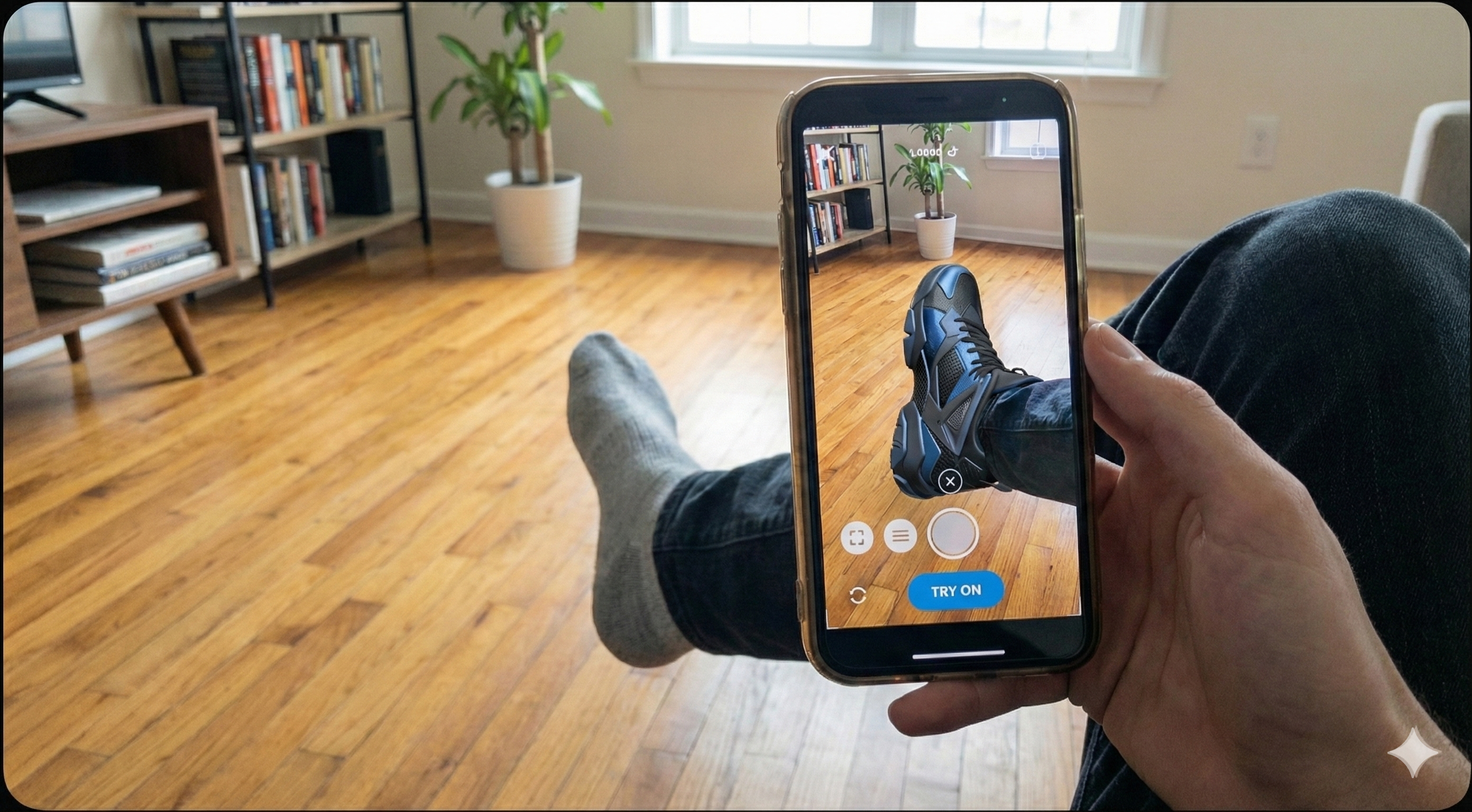
How to Measure VTO ROI
The business impact of VTO can be summarized through three behavioral shifts:
More users add the product to their cart
Users select the right product the first time
Expectation gaps shrink, returns decrease
Cross-device VTO, especially when extended to AI glasses, amplifies ROI by allowing users to evaluate products in multiple real-world contexts. Together, they form VTO’s ROI engine.
What makes this performance data especially important is that engagement rates for 3D and AR try-on are still relatively low across the market. As major platforms like Amazon and Zalando adopt 3D product experiences, consumer expectations are shifting rapidly. Brands investing in 3D today are positioned to benefit disproportionately as engagement continues to grow over the next 1–2 years.
And once you look at your own analytics, you’ll likely see these shifts emerge almost immediately.
To calculate your brand’s exact ROI, try the artlabs ROI Calculator:
👉 Try the artlabs ROI Calculator
FAQ: Virtual Try-On, AI, and 3D Product Experiences
Is VTO still optional, or is it now essential?
It has become essential. VTO now functions as a key decision-making layer on PDPs.
Why does 3D outperform 2D?
3D provides accurate depth, scale, and material behavior, reducing uncertainty.
Do AI Video, 2D Try-On and 3D VTO compete?
No, they form a layered experience that matches different psychological stages.
Does VTO work equally well across categories?
Category logic matters. 3D excels in footwear, eyewear, jewelry, watches, furniture. 2D excels in beauty and fast decision products.
Why does asset quality matter so much?
Because trust depends on visual credibility.
Which metrics matter most?
Activation rate, engagement time, completion rate, ATC uplift, conversion uplift, return reduction.
How can brands estimate ROI?
Through conversion gains, lower returns, and SKU-level insight accuracy.
As immersive commerce expands from mobile screens to AI-powered smart glasses, brands that invest early in scalable 3D infrastructure will define the next era of digital retail.
Bring Scalable, High-Performance VTO to Your Product Experience
If you’re evaluating VTO for your own product experience, the next step is simple. artlabs’ AI-powered 3D infrastructure enables fast integration, optimized assets, instant rendering, and enterprise-grade analytics, redefining how users experience products.
Start your VTO implementation with artlabs.


